
History of Bowling in Scotland and Internationally
Bowls and the Scots
As with golf, the game of Bowls owes its existence to the Scots. The rules are broadly similar all around the World.
Following on a meeting in Glasgow in 1848, attended by about two hundred players from various clubs all with different Laws for playing the game, W.W. Mitchell of Glasgow, drew up a "uniform code of Laws", and these are the basis of all subsequent Laws.
 In 1892, the Scottish Bowling Association was formed and in 1893, it drew up rules or Laws based on Mitchell's Code and also published a Code of Ethics. The Scottish Bowling Association is now Bowls Scotland. In 1903, the English Bowling Association was formed, the first President being Dr. W. G. Grace, who is much more acclaimed and remembered for his fame as a cricketer.
The International Bowling Board was formed in 1905, the foundation members being Scotland, England, Ireland, and Wales. New Zealand was first admitted in 1928, as also were Australia, Canada, South Africa, and the United States of America. The IBB is now known as World Bowls.
Note: The above information is reproduced from the website of Bowls Canada who provide a full history of the sport of lawn bowling. (Visit their site)
The following article comes from the website of the San_Francisco Recreation and Park Department. Once again it recognises the Scottish Connection.
The History of Lawn Bowling
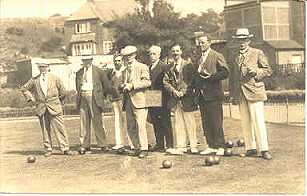 Bowls historians believe that the game developed from the Egyptians. One of their pastimes was to play skittles with round stones. This has been determined based on artifacts found in tombs dating circa 5,000 B.C. The sport spread across the world and took a variety of forms, Bocce (Italian), Bolla (Saxon), Bolle (Danish), Boules (French) and Ula Miaka (Polynesian). The sport of lawn bowls is the forerunner of curling, a tremendously popular winter version played in northern countries (including Canada) on ice.
The oldest lawn bowls site still played on is in Southampton, England. Records show that the green has been in operation since 1299 A.D. There are other claims of greens being in use before that time, but these are unsubstantiated by proper or sufficient documentation. During the reign of Richard II bowls were referred to as "gettre de pere" or "jetter de pierre," and describes throwing a stone, probably as round as possible. In the early 15th century bowls were made of hardwoods and, after the 16th century discovery of Santo Domingo, of lignum vitae, a very dense wood.
It's believed that the "bias" was introduced inadvertently in 1522 by the Duke of Suffolk. Apparently his bowl split in two after striking other bowls and he took a knob off of a stairway banister post for a replacement. The flat side of the knob caused it to roll with a bias and he experimented by curving his bowl around others. The word spread and biased bowls gradually came into use.
Certainly the most famous story in lawn bowls is about Sir Francis Drake and the Spanish Armada. On July 19, 1588, Drake was involved in a game at Plymouth when he was notified that the Spanish Armada had been sighted. The tale says his response was, "There is plenty of time to win the game and thrash the Spaniards too." He then proceeded to finish his match and the British Navy soundly defeated the Armada. There is a lot of controversy as to whether this event actually took place.
Henry VIII was also a lawn bowler. However, he banned the game for those who were not wealthy or "well to do" because "Bowyes, Fletchers, Stringers and Arrowhead makers" were spending more time at recreational events such as bowls instead of practicing their trade. Henry requested that anybody who wished to keep a green pay a fee of 100 pounds. However, the green could only be used for private play and he forbade anyone to "play at any bowle or bowles in open space out of his own garden or orchard." King James I issued a publication called "The Book of Sports" and, although he condemned football (soccer) and golf, encouraged the play of bowls.
English and Scottish colonists brought the game to America. There was a bowling green in Williamsburg, Virginia in 1632 and many states have towns named "Bowling Green" due to the early settlers abiding interest in the sport. Even George Washington laid out a green at Mount Vernon in 1732.
Interest lapsed for years until the wave of Scottish immigration to the US revived it in the latter part of the 19th century. The American Lawn Bowls Association (now Bowls USA) was established in 1915, more than a decade after the founding of the SFLBC.
